


China Website Localization:
Best Practices for Foreign Brands
TheFrom indexing regulations to user behavior signals, the factors that determine your website’s visibility in China are shaped by local infrastructure and specific digital content laws.
For foreign companies entering the Chinese market, this means your efforts for website localization in China must extend far beyond simply translating content into the local language.
In our experience, it involves several technical and strategic decisions, including selecting compliant web hosting, securing an ICP filing or commercial license, and structuring content to ensure Chinese search engines can properly crawl and index your web pages.
When these elements are implemented correctly, brands become easier to discover and more credible to Chinese consumers. Without them, even well-designed websites often struggle to appear in search results across China’s digital landscape.
Why Do Foreign Brands Need To Conduct Website Localization In China?
Foreign companies cannot rely on global websites or standard international SEO practices when entering the Chinese market. Localizing your website ensures that the brand’s digital presence complies with local regulations, performs reliably on China’s network infrastructure, and aligns with local user expectations.
Chinese website localization also affects how local search engines such as Baidu index and rank a website. Site hosting location, regulatory compliance, language format, and domain structure all influence crawlability and visibility in China.
Without these adjustments, even a fully translated website may struggle to load quickly, rank well in search results, or build credibility with local users.
Key reasons why website localization is necessary in China:
- Over 1 billion Chinese internet users primarily browse and prefer content written in Simplified and traditional Chinese.
- China’s language law sets standard Chinese as the baseline for online content in the domestic cyberspace.
- An ICP filing or an ICP license (ICP备案) is required for legally operating websites in China.
- Chinese search engines like Baidu prioritize locally hosted and optimized websites.
How We Implement China Website Localization for Foreign Brands
>Website localization in China requires aligning your infrastructure, compliance setup, content strategy, and user experience with how local search engines crawl websites and how Chinese users browse, compare, and convert online.
Our Chinese website localization framework at Sekkei Digital Group is built to help foreign brands create web pages that load faster in China, are easier to index on Baidu, and are more credible to local users from the first visit.
Discovery, Audit, and Localization Strategy
The first stage is about understanding whether your current global website can realistically support China, or whether parts of it need to be rebuilt, migrated, or restructured for the local market.
Many foreign brands assume their existing site only needs to be translated into Simplified Chinese. However, the bigger issues often involve inaccessible scripts, blocked third-party tools, weak website speed in mainland China, and content structures that do not align with Baidu’s indexing behavior.
We review the purpose of your website content. Some brands need a Chinese website primarily for brand presence and credibility. Others need lead generation, distributor support, product education, or e-commerce readiness.
These goals affect everything that follows, from infrastructure choice and domain planning to content depth and conversion design.
What we clarify in this Chinese localization process:
- Business and marketing goals for the China website, including brand presence, lead generation, e-commerce, or distributor support.
- Current website setup, including hosting environment, CMS, source code flexibility, and reliance on third-party tools.
- Existing Chinese content, if any, current Baidu SEO visibility, and other relevant web pages for Chinese search engines.
- Technical or compliance risks that may affect accessibility, speed, crawling, or launch readiness in China
We also identify issues that are especially important in China, such as the use of Google Fonts, Google Analytics, YouTube embeds, reCAPTCHA, or other foreign scripts that may slow down or break parts of the user experience in the Chinese market.
Infrastructure Setup: Hosting Options, CDN, and Compliance
Infrastructure decisions directly impact performance, legality, and search visibility in China.
A well-written Chinese website can still underperform if it is hosted in the wrong location, uses non-compliant infrastructure, or depends on assets that load poorly behind China’s internet controls.
That is why we treat infrastructure setup as a core localization process, especially for foreign businesses trying to build brand perception and credibility in the Chinese market.
Recommending the Best Hosting Solutions
We recommend hosting based on your launch timing, technical needs, and growth plans in the Chinese market. For some brands, mainland China hosting is the right long-term choice because it offers better local speed and stronger support for domestic search performance.
For others, Hong Kong hosting or a China-optimized CDN structure may be a more practical first phase while compliance or internal approvals are still being completed.
Our recommendations consider:
- Whether the website needs full mainland China hosting or a phased setup using Hong Kong infrastructure.
- Whether your CMS or tech stack is compatible with a China-friendly deployment model.
- How static assets, media files, and scripts will perform for Chinese customers.
- Whether approved CDN support is needed to reduce latency and improve stability across regions in the Chinese market
It’s worth noting that many foreign Content Delivery Networks (CDNs) are banned in China. So, if you’re considering using this method to localize your website, we recommend choosing a CDN service with a reliable network within the country. If the data comes from a nearby server, local users can receive the information they request faster when browsing your website.
This stage is especially important because speed issues in China are rarely just a design problem. They are usually tied to server geography, routing, blocked resources, and script dependencies.
Managing the ICP License Application Process
Launching a website hosted in Mainland China requires compliance with the Internet Content Provider (ICP) registration system. The process is administered by China’s Ministry of Industry and Information Technology (MIIT) and applies to any company, Chinese or foreign, that hosts a website on servers located in the country.
The requirement simply authorizes the site to operate legally in the country and confirms that the website has been registered with the Chinese government.
We guide foreign brands through the full ICP application process, ensuring that the hosting environment, domain ownership, and company documentation are prepared correctly before submission. Because the process requires coordination with local hosting providers and regulators, it’s best to address it early in the Chinese website localization timeline.
Two main ICP certifications apply depending on the purpose of the website:
- ICP Filing (ICP备案): This applies to informational or non-commercial websites. Corporate websites, brand pages, product catalogs, and B2B lead-generation websites typically fall into this category. It can be submitted by companies or individuals, and typically takes around 3 to 4 weeks for approval after submission.
- ICP Commercial License (ICP经营许可证): Websites that conduct direct online transactions must apply for an additional commercial ICP license. This applies to businesses running ecommerce operations, online marketplaces, or subscription-based services to Chinese consumers. This license enables several important marketing-related capabilities, such as processing online payments via platforms like WeChat Pay and Alipay, and running digital advertising campaigns tied to e-commerce conversion tracking.

Completing the PSB Filing Requirement
After the website becomes publicly accessible, it must also complete the Public Security Bureau (PSB) Filing (公安备案). This registration links the website to China’s cybersecurity monitoring system and confirms the site operator’s identity.
This process verifies if these online platforms and their data comply with the security standards set by the local government laws.
Key Requirements for PSB Filing:
- An approved ICP Filing
- Business license, domain ownership proof, and ID information
Once approved, you receive a PSB registration number that must be displayed on your homepage, typically in the footer alongside your ICP number. Skipping this step where applicable can expose an otherwise compliant site to takedown, so it should be scoped at the same time as your ICP filing.
Planning Any Required Site Migration
In many cases, a global website cannot simply be mirrored into a Chinese hosting infrastructure. Migration planning must account for CMS compatibility, third-party integrations, and the removal or replacement of services blocked by China’s Great Firewall policies.
We evaluate whether the existing website can be migrated directly or not.
This step includes planning around:
- URL structure and Chinese-language site architecture.
- Server migration risks and downtime control.
- Removing blocked third-party scripts such as Google Analytics, Google Maps, or YouTube embeds.
- CMS limitations that may affect localization, caching, or deployment in China.
- Implementing China-friendly analytics and marketing tools.
- Separating the Chinese website from the global domain (for example, cn.domain.com or a dedicated .cn domain).
Supporting Domain Name Registration
As of late 2024, the country had over 33 million domain names. This includes more than 20 million ending in .CN, which shows how established local domain infrastructure already is in the Chinese internet environment.
We support brands in assessing whether they should use their global domain, a China-focused subdomain, a simplified Chinese brand domain, or a new domain better suited for market recognition and compliance.
We also review ownership details, registrar compatibility, DNS management, and whether the domain setup supports future ICP filing, local hosting, and long-term China SEO efforts.
For brands with trademark or brand protection concerns, this stage is also important for reducing the risk of domain fragmentation or inconsistent branding across the Chinese market.
UX, Design, and Content Localization
A China-ready website must reflect how Chinese users browse, compare, and evaluate brands. That means localization is not limited to language accuracy. It also affects page flow, information hierarchy, mobile usability, content density, and trust-building cues.
User Experience and Layout
Chinese consumers are overwhelmingly mobile-first, and Baidu also maintains explicit mobile adaptation guidance for sites serving different desktop and mobile user experiences.
That means user interface designs should prioritize mobile usability from the start, including lighter page structures, clear section hierarchy, fast-loading assets, visible inquiry actions, and layouts that support scanning on smaller screens.
We simplify navigation, reduce unnecessary decision points, and adapt page structures to how Chinese customers compare products, verify company credibility, and contact suppliers.
Content Translation and Creation
Chinese website content must read naturally in simplified Chinese, reflect sector-specific terminology, and match the communication style expected by Chinese audience segments. That often means rewriting sections rather than relying on direct machine translation tools.
One structural factor many foreign brands overlook when implementing website translation is how Chinese characters (汉字 / 汉字) affect page design. Local text conveys meaning more densely than English, which changes how headings, menus, and content blocks appear visually.
A phrase that takes six or seven English words may only require two or three Chinese characters, while technical explanations may expand depending on the terminology used.
Because of this writing system, layouts designed for English often look either overly compressed or awkwardly spaced once translated into simplified Chinese.
Tip: Match the script and the brand tone to your audience.
Simplified Chinese is the right default for mainland China, used by the overwhelming majority of the market. Meanwhile, traditional Chinese is typically used in Hong Kong, Macau, and Taiwan.
Language is only the first decision, though. Chinese also distinguishes formal (您) and informal (你) forms of address, and the choice shapes how your brand is received locally. A formal register or tone may suit technical documentation, financial services, and B2B campaigns, while a more casual tone fits consumer and lifestyle content marketing strategy.
This is why machine translation falls short. Tone, idiom, and regional slang carry meaning that automated tools flatten, and for headlines or campaign copy,
SEO-aligned Copy
Chinese SEO differs from Western search optimization because Baidu prioritizes certain ranking signals differently. During localization, what we do is adapt titles, headings, and page structures to match how Chinese users search online.
This includes:
- Chinese keyword research tailored to Baidu search behavior.
- Structuring pages to emphasize keyword relevance in headings and metadata.
- Creating internal linking structures that reinforce topic authority.
These adjustments help localized pages gain visibility within Chinese search results.
Trust Signals
Chinese users often quickly evaluate website credibility, especially when engaging with foreign brands. We therefore localize trust signals as part of the page strategy.
This can include visible certifications, partner logos, company credentials, local office or distributor details, market-specific case studies, contact methods familiar to Chinese users, and clearer proof of operational legitimacy.
Trust-building elements are especially important for:
- B2B industrial brands
- Healthcare and beauty brands
- Education providers
Software and technology companies - High-consideration services entering China for the first time
Without these signals, even well-written pages may struggle to convert Chinese customers.
Replacement of Blocked Third-Party Integrations
A site that performs perfectly on a Western staging server can break silently behind the Great Firewall. The cause is usually a dependency on blocked third-party services. And because the failure is partial, it often goes unnoticed until a Chinese user reports a broken page.
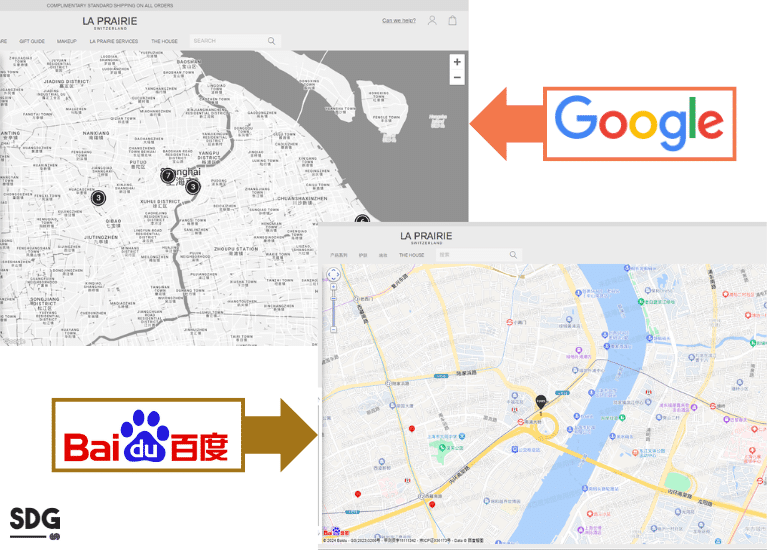
The most common culprits are Google services: Google Maps, Google Fonts, reCAPTCHA, Analytics, and any hosted libraries served from Google’s CDN. YouTube embeds and many Western video and tag management scripts fail in the same way. Each blocked call can stall page rendering while the browser waits for a response that never arrives.
Before launch, audit every external script and swap blocked services for local equivalents: Baidu Maps in place of Google Maps, Youku or Tencent Video for embedded video, and locally hosted fonts instead of Google Fonts. Beyond preventing breakage, local integrations align your site with the tools Chinese users already expect, improving both performance and familiarity.
QR Codes And Private Traffic
The Chinese market is highly adept at using technology. With the country’s digital landscape rapidly evolving, your potential customers expect you to answer their queries quickly. One effective strategy to cater to these preferences is adding a live chat customer service option on your website. Chinese users are tech-savvy, so talking to AI chatbots is not new to them.
A large share of Chinese consumers also scan QR codes as a routine part of browsing and buying, making them the primary bridge from your website to your owned channels. They may route visitors to your WeChat Official Account, Mini Program, or storefront, converting anonymous web traffic into “private traffic” you can re-engage directly.
Build, Integration, and Testing for China
Once the infrastructure, content, and design strategy are finalized, the website enters the development and testing phase. This stage ensures that every component functions properly for potential Chinese customers.
For our website localization services in China, we often test for:
- Page loading speed validation within the Chinese market.
- CDN performance across major Chinese cities.
- Compatibility with Chinese browsers and mobile devices.
- Form submission and lead capture testing.
- Baidu crawling and indexing readiness checks
Many websites that function well globally encounter performance issues in China if these tests are not conducted properly. Thorough validation helps prevent those problems before launch.
Post Website Launch Validation & Optimization
Chinese website localization does not end when the site goes live. Continuous monitoring and optimization are necessary to ensure that the website performs effectively within China’s digital ecosystem.
We also submit the website to Baidu Webmaster Tools and conduct ongoing optimization to improve visibility in search results.
As search performance data accumulates, content and technical improvements can be implemented to strengthen the website’s long-term effectiveness within the Chinese market.
SDG’s Successful China Website Localization Projects
ARKAMYS
ARKAMYS partnered with our team to localize its digital presence for the Chinese market. As a global provider of automotive audio software to car manufacturers, the brand needed a website that clearly communicated its technical expertise to Chinese OEM partners and industry stakeholders.
Solutions We Executed
Beyond establishing brand presence on Chinese social media platforms, we adapted ARKAMYS’s website to meet China’s technical and regulatory requirements while ensuring the brand remained discoverable for Chinese industry audiences.
We translated and restructured key website pages into simplified Chinese, implemented infrastructure suitable for China-based hosting, and supported ICP registration and local domain configuration to ensure compliance and stable performance.
Campaign Outcomes
The localized website significantly improved the brand’s accessibility for Chinese automotive industry stakeholders and strengthened its digital credibility within the local ecosystem.
- Optimized Chinese-language pages for Baidu discovery.
- Faster and more stable website. loading within China
- Clearer product messaging tailored for Chinese OEM audiences.

FOCAL
FOCAL worked with our team to rebuild its website for the Chinese market. As a globally recognized manufacturer of premium audio solutions, the brand required a China-ready digital presence that delivers consistent performance and communicates the value of its products to its target Chinese audience segments.
Solutions We Executed
For this China website localization project, we evaluated FOCAL’s global website infrastructure and adapted it to function reliably within the Chinese digital ecosystem.
Our team replaced incompatible plugins, optimized site performance through China-based hosting, and localized key pages into simplified Chinese. We also supported ICP registration and adjusted technical elements such as metadata and page structures to improve compatibility with the Baidu search engine.
Campaign Outcomes
Following the launch of the localized website, FOCAL established a stable digital presence, allowing Chinese audiences to access product information and brand content without the performance limitations of the original global site.
- Consistent page accessibility for users inside Mainland China.
- Improved website compatibility with Chinese browsers and networks.
- Stronger technical foundation for future China-focused content expansion

Why Unlocalized Foreign Websites Underperform in China
Even well-designed international sites can become slow, partially inaccessible, or difficult to discover through Chinese search engines if they are not adapted to local technical requirements and user expectations.
Global websites that do not account for China’s Great Firewall policies frequently experience poor indexing, slow load times, and limited visibility.
Some of the most common reasons include:
Overseas Hosting
Websites hosted outside mainland China often experience latency due to cross-border routing and filtering by the Great Firewall. This can lead to slow page loads or even partial page failures.
No ICP License
As mentioned before, websites serving Chinese consumers are generally expected to obtain an ICP filing under the local internet regulations. Without it, foreign brands may face legal limitations, especially when attempting to establish a compliant digital presence in China.
Content Not Optimized for Chinese Search Engines
Local search engines such as Baidu prioritize simplified Chinese content, localized keywords, and China-specific metadata structures. English pages or poorly translated content rarely rank well.
Blocked or Slow Third-party Tools
Many Western tools commonly used on global websites are restricted or unreliable in China, including Google Analytics, YouTube, and Google Fonts. These dependencies often break page elements or delay loading.
Why Unlocalized Foreign Websites Underperform in China
Different industries face different regulatory environments, customer journeys, and platform ecosystems. Because of this, our China website localization strategies adapt based on how Chinese users in each industry discover brands, evaluate credibility, and convert.
Below is how our approach varies by industry.
B2B
In many of the B2B marketing campaigns we launched in China, we often utilize websites to prove a brand’s credibility and digital authprority. Localization in this sector focuses heavily on technical clarity, search visibility, and trust signals that help Chinese buyers evaluate potential partners.
Chinese buyers usually discover suppliers through industry platforms, distributors, or search engines like Baidu, then visit the official website to verify technical capabilities, product specifications, and company reliability.
Important B2B website localization considerations include:
- Technical product pages optimized for Chinese search behavior, including simplified Chinese specifications, datasheets, and product applications.
- Baidu-oriented SEO structures, ensuring page titles, metadata, and internal linking align with how Chinese buyers search for suppliers.
- Clear inquiry and distributor contact pathways, allowing Chinese companies to submit RFQs or partnership requests easily.
- Strong credibility signals, such as certifications, manufacturing capabilities, industry partnerships, and project case references.
Tourism and Hospitality
When it comes to travel marketing in China, the website plays a different role. Chinese travelers typically discover destinations through social platforms, OTAs, and influencer content, then visit the official website to validate information, review amenities, and plan bookings.
Localization in this industry focuses heavily on visual storytelling, travel information, and trust signals that resonate with Chinese travelers.
Important localization considerations include:
- Destination content tailored to Chinese travel interests, including attractions, itineraries, and travel tips.
- Mobile-first layouts, since Chinese travelers research and plan trips primarily on mobile devices.
- Integration with Chinese travel ecosystems, such as linking to booking platforms or WeChat contact channels.
- Localized seasonal content, aligned with major Chinese travel periods like Golden Week and Chinese New Year
FMCG
For FMCG marketing campaigns in China, the brand’s website often supports brand discovery and validation rather than direct purchasing.
Chinese consumers frequently encounter products on social media, livestreams, or e-commerce platforms, then visit the brand’s website to verify authenticity and learn more about the brand’s story.
Some of the localization strategies we execute for FMCG brands in China are:
- Brand verification and credibility pages, including company background, certifications, and product authenticity guidance to reduce counterfeit concerns.
- Product education built for scanning, with simplified Chinese benefit hierarchies, usage steps, FAQs, and clear claim wording.
- Campaign landing page flexibility so that the site can support QR traffic, influencer links, and seasonal activations without heavy dev cycles.
- China-compatible tracking and performance, replacing blocked scripts and ensuring stable load times for campaign spikes.
Gaming
When launching marketing campaigns for gaming brands in China, we consider brand websites as a channel for announcements, community engagement, and player onboarding.
Chinese players frequently encounter games through social media, livestream platforms, or gaming communities before visiting official websites to learn more about gameplay, characters, and updates.
This is why our localization strategies in the gaming sector focus on community engagement, content updates, and regulatory compliance.
Some of these campaigns include elements like:
- Game content localized for Chinese player interests, including character pages, gameplay features, events, and story elements.
- Landing pages built for launch and live operations, supporting pre-registration, announcements, and campaign updates.
- China-compatible media and page performance, especially for image-heavy and video-driven content.
- Stronger community and trust elements, such as official news sections, support pages, and local contact or social access points.
Localize Your Website for China with Sekkei Digital Group
Foreign websites often underperform in China because they are not optimized for domestic search engines, technical requirements, and browsing habits. Without proper localization, websites may struggle with slow load speeds and limited engagement from Chinese audiences.
If your business is preparing to enter China or improve the performance of an existing Chinese website, get in touch with our team at Sekkei Digital Group to discuss how we can support your localization efforts.
LEAVE A MESSAGE OR
ADD US ON WECOM:
