


Last Updated on April 17, 2026
Nearly half of China’s annual retail revenue comes from its massive online shopping population. As the largest e-commerce market in the world, industry giants are continuously innovating ways to serve the country’s nearly one billion enthusiastic virtual consumers.
Modern Chinese shoppers also increasingly rely on local social media platforms for product discovery, credible recommendations from trusted personalities, and genuine feedback from fellow consumers.
In this article, we’ll discuss how social commerce in China differs from the rest of the world and its impact on domestic consumer behaviors. We’ll also tackle which platforms will suit your digital marketing needs in the long run.
What is social commerce in China?
Social commerce in China refers to the fusion of online user engagement and virtual shopping functions in a single platform. This means that Chinese consumers can discover, discuss, and purchase products in one app without being redirected to a separate website.
Currently, the country has over 1 billion internet users who are actively chatting, sharing, and shopping on mobile devices. Thanks to social commerce channels, the average consumer journey becomes shorter and accommodates the fast-paced consumption patterns of online shoppers.
The prevalence of social shopping is also partly influenced by the trust locals place in recommendations from friends, family, fellow customers, and influencers.
An early example of this trend emerging in China’s digital ecosystem is a makeup tutorial on Douyin, where users became capable of showcasing a product and providing a direct link for purchase.

Over time, even traditional cross-border e-commerce giants like Taobao and JD.com decided to integrate social features into their systems.
From letting brands host live-streaming sessions to sharing media content, online shopping has become more dynamic than ever and is ready to cater to the changing needs of the younger consumer base.
How big is social commerce in China?
China maintains its position as the most extensive online market in the world, with an overall value of $1.38 trillion in 2025.
No one can deny how massive social commerce is in China, especially with over 71% of Chinese consumers admitting that they prefer shopping on social media instead of traditional e-commerce channels.
Furthermore, an average local internet user spends approximately 5 hours and 15 minutes daily online, nearly half of that time on Chinese social media platforms.
This consumer pattern obviously empowered China’s social commerce market even further, allowing it to reach an annual transaction increase of 7.2% from 2023 to 2024.
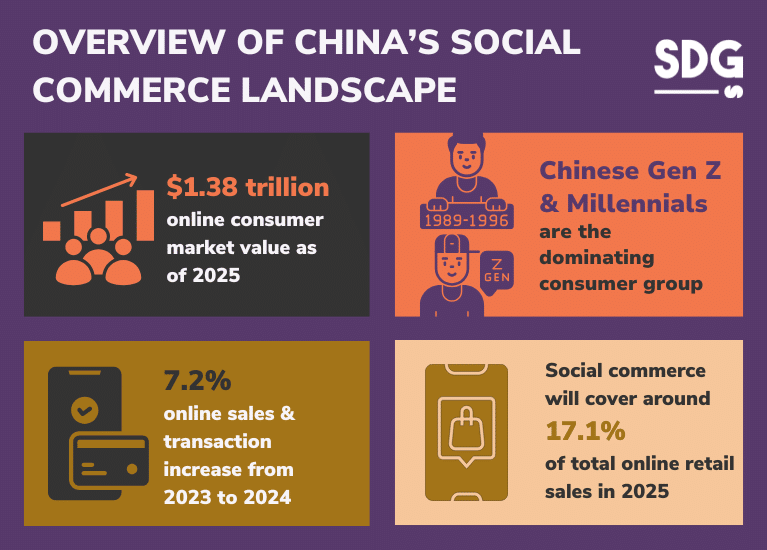
If this upward projection continues, the segment will constitute 17.1% of China’s total online retail sales by 2025, an impressive jump of 14.3% from 2021.
Surging social commerce sales were mainly attributed to younger demographics (Chinese Millennials and Gen Z), particularly those between 27 and 39. This audience segment accounts for 57.8% of the user base.
A significant part of social commerce in China is live commerce (live-streaming + instant buying). This segment alone has exploded in size. The local live-stream e-commerce market hit nearly ¥5 trillion in 2023, an astronomical rise from just ¥420 billion in 2019.
How Different is China’s Social Commerce Market From Other Countries?
Unique digital and corporate infrastructure
China’s internet landscape is dominated by a few tech conglomerates that have built all-encompassing ecosystems. In particular, Tencent and Alibaba are the twin titans controlling much of the country’s social media, e-wallet systems, and e-commerce.
These tech giants have created full-scale digital ecosystems that command a staggering 90% market share in the country’s e-commerce scene. They also cover 85% of the local social media usage and 85% of the digital payment transactions within China.

As the line between e-commerce and social media platforms blurs, China’s ever-changing digital consumption has pushed these tech giants to form cross-platform partnerships.
The era of closed ecosystems among local apps is rapidly diminishing, allowing businesses to experience the perks of borderless digital landscapes. The seamless consumer journey between social media and e-commerce makes it easier for regular users to jump from engaging content to making a purchasing decision.
It gives them the convenience of browsing through their private social feeds, stumbling upon a product, swiftly ordering an item, processing e-wallet payments, and having the goods on their way for delivery in just a few clicks.
Digital Culture and Nuances
Chinese shoppers highly value recommendations and reviews from people in their social circle or influencers. Word-of-mouth has long been important in China’s consumer culture, and social media exponentially amplifies it.
While Western consumers do follow influencers, the scale at which Chinese consumers treat social platforms as their primary source of product research is unparalleled (remember, 71% prefer social shopping in China!).

By the mid-2010s, live streaming was already massive in China for gaming, music, and everyday life casting. Viewers got used to tuning into live content nightly for fun. So, when commerce entered the mix (around 2016–2017), watching a salesperson or influencer sell products live felt like just another form of entertainment.
Fast Adoption of New Formats
Chinese users are quick to embrace new digital trends and features. For example, when Taobao Live introduced shopping live streams in 2016, millions tuned in almost immediately, and sales via live streaming skyrocketed.
Their openness to innovation gives local social platforms an edge to experiment and successfully launch new commerce features.
What are examples of social commerce trends in today’s Chinese market?
1. Public Traffic vs Private Traffic
The key advantage of social shopping platforms is their ability to generate different types of audiences for businesses. Depending on your marketing goal, you can use this channel to target new consumer segments via public domain traffic sources like digital advertising.
Meanwhile, a brand with an established presence on social commerce apps can opt to generate leads through private domain traffic sources, like WeChat Mini-Programs.
These platforms operate beyond the capacities of typical social channels, so you have a full suite of tools dedicated to cultivating your existing consumer base or expanding your audience reach.

2. Growth of Group Buying Features
Group buying is another trend that will continue to flourish on social commerce platforms. These features encourage users to make bulk purchases and unlock discounts and exclusive deals.
By leveraging collective group buying, Chinese consumers can access lower prices and enjoy shared benefits. This trend fosters community and excitement as users work together to reach group buying thresholds.

In 2024, group buying features became a typical option across platforms beyond Pinduoduo. Even traditional e-commerce apps and community group chat tools are adopting the tactic to spur viral growth.
Beyond that, Chinese consumers are particularly keen on group buying promotions during public holidays and e-commerce festivals when online consumerism is at its peak.
3. Continued Dominance of Live Commerce
Live commerce, or zhibo daigou (直播代购), continues to be a dominant force in China’s social commerce landscape. This format combines live streaming with shopping, creating a highly interactive environment where viewers can watch product demos, ask questions, and make purchases in real-time.
Platforms like Taobao Live, Douyin, and Kuaishou are some of the leading pioneers of the live commerce trend. High-profile influencers and celebrities often draw millions of viewers to their streams.

What’s new is the scale and professionalism of live commerce now. Top streamers such as Li Jiaqi (Austin Li, the “Lipstick King”) or Viya (before her hiatus) have become celebrities, often garnering millions of viewers in a single session.
These influencers can sell out entire inventories of products in minutes, with sales numbers for one show sometimes rivaling an entire store’s daily revenue.
In 2024, brands are increasingly creating their own live channels, not just relying on KOLs or KOCs. For example, many cosmetics and fashion brands now regularly schedule live demos hosted by in-house personalities.
4. Proliferation of Mini Programs
By late 2024, WeChat had nearly 954 million monthly active users of mini programs on its platform. It means that almost the entire WeChat user base is engaging with mini apps.
Mini programs operate within the main app, allowing users to shop, play games, or even access customer service without needing additional downloads.
This ease of access significantly reduces barriers to engagement, making it simple for users to interact with brands through different content mediums.

Sephora’s WeChat Mini-Program with E-commerce and Live-streaming Options
Mini programs also enable brands to create a more interactive and customized journey, helping build loyalty and retention by allowing users to perform multiple activities in one place.
As a result, brands can leverage the data to fine-tune their strategies and better meet customer expectations in real time.
7 Best Social Commerce Platforms in China
1. Xiaohongshu (Little Red Book)
Xiaohongshu (Little Red Book) first gained a reputation for reliable, authentic reviews of products aimed at female consumers in categories like cosmetics, fashion, lifestyle, and beauty.
However, in recent years, the social media platform has expanded to different product categories. Its diversified features and services help the app gain 300 million monthly active users.

If you want to utilize social commerce in China through this platform, here are key points you must remember about Xiaohongshu:
- One of the most popular live-streaming and vlogging platforms
- Engagement metrics are high, with average users spending 40 minutes a day on the app
- Jointly invested in by Tencent and Alibaba, integrated with both WeChat and Alipay
- It allows brands to capture user interest with content and seamlessly make a conversion
- It has a very young user base, with 90% of its users under 32 years old
2. WeChat
WeChat is widely recognized as the all-in-one super-app in China. While it was initially launched as an instant messaging platform, it has since evolved and now offers social commerce features.
Its evolution has resulted in a complete ecosystem, from social media and e-commerce to mobile payments and video channels.

The utilization of WeChat as a social e-commerce platform brings forth several key advantages that contribute to its popularity:
- Its extensive consumer reach makes the platform a vital marketing tool for businesses looking to tap into the local market.
- Users can seamlessly share and recommend products within their social networks to drive engagement and facilitate word-of-mouth marketing.
- Whether unveiling new products, conducting live demos, or responding to viewer questions, WeChat Channels allow brands to connect more directly with their target viewers.
- WeChat Mini-Programs can be integrated into Channels and official accounts for a seamless consumer journey, from content discovery to purchasing.
- Brands can accept and process digital payments from local consumers through WeChat Pay.
3. Taobao / Tmall Platform (GuangGuang)
Alibaba’s Taobao and Tmall platforms collectively host millions of merchants and virtually every product category sold in China.
While traditionally they were pure marketplaces, in recent years Alibaba has infused them with a heavy dose of social media features, primarily through a unified content hub known as Guangguang. This has turned Taobao/Tmall from shopping apps into interactive social commerce user experiences.
In 2024, about 60–70% of the Taobao/Tmall mobile app interface was dominated by promotional content rather than product listings. This dramatic shift demonstrates how crucial engagement is.

Key advantages of GuangGuang include:
- Taobao and Tmall command a significant presence in the e-commerce industry, ensuring a vast consumer base for social commerce activities.
- Influential Key Opinion Leaders have gained celebrity status through their success in social e-commerce on Taobao.
- Users on Taobao and TMall primarily focus on making purchases, prioritizing buying intent on their algorithms.
- GuangGuang offers a diverse range of special sales events throughout the year beyond the well-known 11.11 festival. These events provide customers with exclusive deals and exciting shopping experiences.
4. Pinduoduo
Another app gaining traction among social commerce platforms in China is Pinduoduo. At first glance, it may appear like a typical shopping app, but it facilitates group buying between friends and acquaintances.
It has over 500 million buyers who can access special discounts by buying as part of teams, thereby leaning heavily toward the tried-and-true digital marketing concepts of social proofing and exclusivity.

Here are the perks marketers and advertisers can expect from Pinduoduo:
- It has daily check-in bonuses for its users
- International brands are more popular on this platform
- It has a gamified feature with time limits for creating teams
- Brands can retain consumer engagement through inbuilt mini-games.
5. Weibo
Often dubbed the Twitter of the local social media landscape, Weibo has defied expectations and maintained its competitive edge amidst the emergence of new and innovative platforms. Over the years, it has proven its resilience by adapting to evolving market demands.
In 2020, the app took a significant leap by transforming into a true social commerce powerhouse by introducing its e-commerce management function, Weibo Xiaodian.
With the launch of Weibo Xiaodian, Weibo gave brands a chance to go beyond simply referring users to external marketplaces. Instead, they gained direct control over inventory management, order processing, and the ability to create their digital flagship store within the platform.
This strategy enables them to establish a robust presence on Weibo, further integrating social interaction with commerce.

Weibo possesses several key strengths that contribute to its continued success:
- Its longevity sets it apart from fleeting platforms. Weibo has demonstrated its enduring presence in social media, consistently proving it is here to stay.
- It boasts a vast user base encompassing diverse demographics across the entire China.
- Weibo is the most suitable platform for finding KOLs for your marketing strategy.
- Weibo’s appeal to influential figures further solidifies its position as a significant social media platform.
- It facilitates seamless communication between brands and customers.
- Its ease of engagement contributes to enhanced customer experiences and strengthens brand-customer relationships.
6. Douyin
Douyin’s journey from a simple video-sharing platform to a social commerce titan is a testament to its innovative approach and understanding of consumer behavior. Today, the app integrates e-commerce features directly into its system, allowing users to purchase products without leaving the app.
The platform’s claim to fame is its powerful AI-driven recommendation engine that serves up an endless feed of short videos tailored to each user’s interests. This “interest graph” approach means even unknown creators (or brands) can get huge exposure if their content hits the right notes.

Here are several key features that have enabled Douyin to become a leading social commerce platform:
- Douyin has an in-app shopping function, allowing users to buy products directly from video content.
- Brands and influencers can add links to their content to lead their audiences to a product page or a Douyin e-commerce store.
- The platform grants the ability to host live shopping events where viewers can purchase products showcased during the stream.
- Douyin utilizes advanced algorithms to analyze user behavior and preferences, providing personalized product recommendations.
7. Meituan Dianping
Meituan Dianping is a “super app” primarily focused on connecting users to a variety of services, including food delivery, hotel bookings, and travel arrangements. It attracts over 678 million active users, with features such as in-store coupons, restaurant reservations, and entertainment bookings.
For businesses, Meituan Dianping is invaluable because it allows them to target consumers seeking recommendations, particularly in travel-focused brands like hotels and entertainment establishments.

To successfully utilize Meituan Dianping for social commerce, consider the following strategies:
- Ensure your business is accurately represented with appealing visuals and informative details.
- Engage key opinion leaders (KOLs) or top reviewers to boost credibility and increase visibility.
- By linking Meituan Dianping with WeChat, brands can enhance user convenience and foster seamless engagement across platforms.
Your Trusted Social Commerce Partner In The Chinese Market!
Consumers in China have unique preferences and behaviors when using social commerce platforms. To truly captivate their interest and achieve the desired marketing goals, it is crucial to customize your approach and understand the intricacies of the local market.
You may also want to read:

Don’t let the complexities of the domestic market hold you back! Our experienced team is here to guide you through every twist and turn, helping your brand build an audience on local social commerce platforms.

Whether it’s crafting compelling marketing campaigns, harnessing the power of SEO and social media, or making waves with PR, we have the digital solutions you need. Contact us today, and let’s start working together!
