


Last Updated on July 16, 2026
As the largest search engine in China, Baidu is a platform you can’t skip when conducting SEO. Beyond its massive user base, this marketing channel operates with more sophisticated algorithms and technologies than other search-based platforms in the local market.
With the right strategy, marketers can seize the opportunity to improve their web content ranking within Baidu’s search results and generate organic traffic from a highly relevant audience segment.
To help you achieve this outcome, we’ll guide you through the most effective Baidu SEO practices and offer expert insights on today’s China search market trends.
What is Baidu used for?
Baidu is a multinational technology company that offers Internet-related services and products. However, it is best known as the provider of China’s most-used search engine.
With Google-related apps restricted and heavily censored in the country, the domestic platform primarily caters to the online search needs of the Chinese market. Following China’s stringent digital content laws, this search engine mainly prioritizes websites in the local language.

Compared with other search engines in China, Baidu has a larger user base, with over 679 million monthly active users.
Right now, the platform accounts for 47.4% of the local market share. Given its expansive reach and market dominance, conducting search engine optimization efforts for the platform has become the norm among domestic and foreign businesses, especially for new brands trying to break into the Chinese market.

SDG’s Work With Roche: Baidu SEO Implementations
Beyond being a widely known Chinese search engine, Baidu offers users access to other services in its ecosystem, from social communication to knowledge sharing and entertainment. Content created within these landscapes is often favored by the platform’s algorithm, making it a critical aspect of SEO.

Here are some of the content marketing features foreign brands can utilize when conducting SEO in China:
● Baidu Zhidao
This local Q&A forum is famous for its high community engagement. It’s where Baidu users can post questions or provide answers based on expert knowledge and recommendations.
Building a presence using this service allows foreign brands to increase visibility in Baidu SERP, as these search queries and answers are recognized as credible user-generated content.
In addition, these forum discussions answer important queries about your business or industry, which could prompt a highly targeted audience to visit your brand’s Chinese web pages.

Example of a question posted on Baidu Zhidao for our client Merck
● Baidu Baike
Instead of Wikipedia, the platform offers Baidu Baike. It’s a popular information source that Chinese internet users rely on to find unbiased, trustworthy data on specific topics and keywords. Unlike its Western counterpart, this paid service serves a commercial purpose.
Businesses can post brand-related articles on Baike, creating an opportunity to execute Baidu search engine optimization strategies. Not only can the content appear on top of Baidu SERPs, but it can also build a positive reputation around your brand.
And while this service allows companies to post content, remember that the articles will still undergo rigorous verification processes.

● Baidu Tieba
With over 300 million monthly users, this forum service accounts for more than 10% of Baidu’s overall traffic. It has an uncanny similarity with Reddit, where people can discuss and follow specific topics.
The platform thrives on user-generated content, allowing brands to engage with their targeted Chinese audience. Marketers can also create a bar for their brand, including details such as social media accounts and websites. Doing this can also help your content appear on search engine results when users search for terms related to your business.

Example of an article posted on Baidu Tieba for our client Merck
How does Baidu SEO work in China?
Much like Google SEO, Baidu SEO in China primarily aims to deliver the most relevant and high-quality content to its target audience. To achieve this, brands must consider various on-site and off-site factors such as keyword relevance, content quality, website structure, and backlink profile.
The only problem is that Baidu SEO is bound to unique nuances and user behaviors that differ significantly from those in the Google search console. Like other Chinese search engines, Baidu’s ranking factors do not favor non-Chinese websites or content that doesn’t resonate with the local market.

Keeping these things in mind, it’s crucial for a brand aiming to enter the Chinese market to tailor its SEO strategy to meet Baidu’s specific requirements. We recommend localizing your website not only through content translations but also by obtaining ICP licenses, optimizing for domestic keywords, adapting to mobile-first configurations, and more.
10 Best Baidu SEO Practices Foreign Brands Should Know
1. Localize Website With Simplified Chinese Characters
As we mentioned in the article, the Baidu index does not prioritize non-Chinese-language sites, as the local search engine is programmed to interpret Chinese text.
When localizing a website, brands should note that Baidu is predominantly available in simplified Chinese. Although the platform supports traditional Chinese characters, it often converts queries to simplified characters.
Inaccurate translations can undoubtedly affect your site’s ranking on Baidu. So, if you want better results, you can consider working with a Chinese company with industry experience in translation and content creation. These experts will be familiar with the search terms that most accurately translate the brand’s original content.

Example of the global website of our client Rioja Wine and its Chinese version
2. Get a Chinese Website Domain Name
If you want to rank high in Baidu’s search engine results, foreign brands must ensure that their Chinese websites do not mix with their English web pages. The best way to resolve this dilemma is to host your website in Mainland China and get an Internet Content Publishing license.
If you intend to use a website for commercial or sales purposes within the Chinese digital landscape, getting a business-level ICP license is legally required. The easiest way to go about this process is to work with a Baidu SEO agency or partner with a Chinese company to represent the business locally on your behalf.

Example of our client Rioja Wine’s Chinese website with a Chinese domain name, Chinese hosting, and an ICP number
If neither of those things is possible, it’s still possible to register a .cn domain and get hosting in Hong Kong or Korea for fast speeds, but this limits the scope of the business operations the website may perform. Getting a .cn domain also improves the chances of your web content and landing pages ranking on Baidu search results.
Domain and URL architecture is itself a Baidu ranking signal, and foreign brands frequently under-optimize it. Once a brand secures a .cn or .com.cn domain and completes ICP registration, URL paths should be structured around Pinyin transliterations of core Chinese keywords rather than English slugs. This is because Baidu’s crawler still favors Pinyin or numeric paths over English strings when the on-page content is Chinese.
3. Conduct Keyword Research & Define Meta Descriptions/Tags
A massive part of Baidu search engine optimization is adding relevant keywords to your content to reach the right audience.
Marketers must conduct thorough keyword research based on popular terms on Baidu SERP. They should also conduct a market study to see how their industry competitors rank on Baidu and what strategies they use to achieve better results.
Unlike Google, Baidu SEO favors precise keywords, so your priority should be adding relevant title tags and image descriptions for your content. You can also use the platform’s built-in back-end tools, such as Baidu Index and Baidu Keyword Planner.
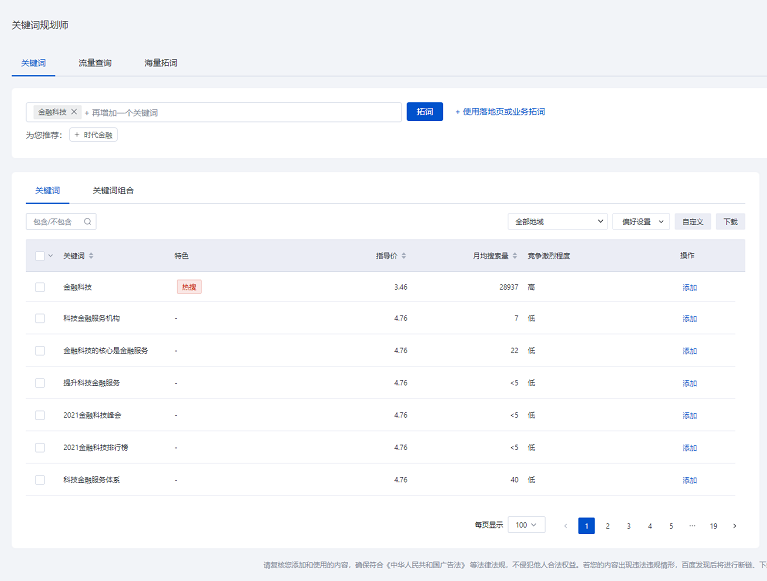
Example of Baidu Keyword Planner, with prices, monthly search volumes, and competitiveness
While Google SEO now focuses on content quality and relevance, Baidu still places a high value on metadata. So, you must take extra caution and research when adding Meta Description, Meta keyword tags, Title Tags, H1/H2 Tags, and Alt Tags. The search engine’s servers are actively crawling these elements, so we strongly recommend you keep them in simplified Chinese. It should also improve your website’s ranking on Baidu search results.
Effective Baidu keyword research also means building a Chinese-first keyword architecture using Baidu Index, Baidu Keyword Planner, and Baidu’s autosuggest/related-search panels to surface how the local audience actually phrases queries. This includes simplified-vs-traditional variants, regional slang, and category-specific abbreviations.
Title tags should front-load the highest-priority keyword within the first 10–15 characters, since Baidu truncates titles more aggressively than Google on mobile SERPs. Meta descriptions should stay under roughly 120 Chinese characters and include a clear call to action.
4. Create and Optimize Relevant Content for Chinese Users
A guide to Baidu SEO wouldn’t be complete without our emphasis on relevant content. No matter how many keywords you integrate into your content, the reality is that this Chinese search engine prioritizes original, high-quality posts.
As with Western search engines, trends within the local digital landscape come and go quickly. Because of this, marketers must always be on guard for the latest updates and topics within their industry.

SDG’s work with Macom: SEO Link Building & Content Marketing
The frequency of your website posts also affects your website’s ranking on Baidu. An active site with new content is more likely to achieve better positioning in local search results than an inconsistently updated one. However, you should be wary of duplicate posting, as it could reduce content quality and rating.
We recommend publishing 2–4 substantive articles per month on the owned domain, supplemented by weekly or biweekly distribution to Baidu’s earned-media ecosystem (Baidu Baike, Zhidao, Tieba, and the Chinese-language trade press).
Content should be organized into topic clusters that signal topical authority to Baidu’s algorithm and provide the site with an internal linking structure. Before publishing, run every piece through a compliance screen: flag content referencing sensitive political topics, unverified medical/financial claims, or superlative language (“best,” “guaranteed,” “#1”) that could trigger Baidu’s content review filters or, in regulated categories like healthcare and finance, run afoul of Chinese advertising law. Agencies with in-market editorial teams typically build this screen into the CMS workflow so it doesn’t add publishing delay.
5. Build Quality Internal & External Links
Another Baidu SEO strategy not all marketers know is that the platform often ranks websites with many relevant backlinks at the top of organic search results. Links from and to high-authority Chinese websites are always best.
Typically, the content Baidu prioritizes on its search engine results page includes backlinks from official sources such as newspapers or Chinese government websites.

Examples of Backlink articles for our client Merck
When it comes to this Baidu SEO strategy, remember that quantity matters. While inbound links from authoritative sites are excellent ranking factors, getting backlinks from less reputable websites is equally important. On top of that, don’t forget to anchor internal links that can lead your audience to another related web page within the website. This structure helps the Baidu spider to weave your content together and increases your odds of climbing the rankings.
Baidu Zhidao Backlink Strategy
Baidu Zhidao (百度知道) backlink building works differently from conventional guest-post link building. Because it’s a Q&A platform, the highest-value links come from being cited as the answer to a real, high-search-volume question in your category, not from posting a promotional answer.
The typical workflow: (1) Identify unanswered or poorly-answered questions in your niche using Baidu Index and Zhidao’s own search bar. (2) Have a network of aged, reputation-scored Zhidao accounts post the question, with a separate account providing a detailed, non-promotional answer that cites your domain as a source. (3) Stagger question/answer pairs over several weeks rather than posting many at once, since Baidu’s spam detection flags sudden bursts of new accounts linking to the same domain.
6. Use HTTPS instead of HTTP
Baidu’s SEO algorithms highly value the HTTPS protocol primarily for its security. It requires you to purchase an SSL certificate from within China. After it’s purchased and applied, submit a new sitemap.xml to the Baidu search console. A good marketing agency can help smooth out this sometimes-puzzling process.

When using HTTPS, data is transmitted securely via SSL, which is highly regarded by search engines. While SSL prioritizes the safety of data transfer, HTTPS focuses on the integrity of the presentation of data.
This dual benefit makes HTTPS an ideal choice for websites. It enhances the user experience while maintaining protection during data transmissions across various interactions. Together, HTTPS and SSL collaborate to establish a secure online environment.
7. Prioritize Mobile Optimization
China is a “Mobile-First” country, with over one billion users accessing the digital landscape through their phones. About 78% of this user base uses mobile search daily for various queries and purposes.
Given its high penetration rate among Chinese internet users, mobile optimization has become a ranking factor in Baidu. Mobile-friendly websites will be ranked much higher in desktop and mobile search results.

Baidu will likely transcode your website if you do not optimize for mobile. It means taking the data onto their servers and automatically making it ‘mobile search friendly.’ Suffice it to say that their automatic conversion might align with a different definition of ‘mobile-friendly’ from the one you follow.
The search engine offers a mobile-page framework roughly analogous to Google’s now-retired AMP, sometimes bundled under Baidu’s “MIP” (Mobile Instant Pages) initiative, which can improve mobile load speed and search visibility for content-heavy pages like blog articles or product guides.
Brands that skip responsive design or MIP risk Baidu auto-transcoding their site into a stripped-down mobile version that often breaks navigation, strips branding elements, and degrades user experience. And once Baidu has transcoded a domain, reversing that classification typically requires a manual reconsideration request through Baidu Ziyuan.
Beyond responsive design, mobile-specific technical priorities include compressing hero images to under 200KB, avoiding pop-up interstitials that cover primary content (a factor Baidu penalizes similarly to Google), and testing load speed specifically from mainland China IPs, since CDN performance measured from outside China (e.g., Hong Kong or Singapore nodes) does not reliably predict in-country load times.
8. Conduct Backend Maintenance
Backend maintenance directly affects how quickly Baidu can discover, crawl, and index your website. Start by submitting your sitemap through Baidu Ziyuan (百度资源平台), Baidu’s equivalent of Google Search Console. Your sitemap should use a proper .xml format, such as sitemap.xml, and should be kept up to date whenever new pages are published or existing pages are changed.
Before submitting, verify domain ownership in Baidu Ziyuan. This can usually be done through an HTML file upload, meta tag, or DNS record. Once verified, Baidu can access your site data, crawl reports, and indexing tools more effectively.
For ICP-licensed websites, Baidu Ziyuan also provides URL push options, including quota push and API push. These tools allow brands to notify Baidu of new or updated URLs rather than waiting for Baidu to discover them through routine crawling. This is especially useful for newer websites or foreign-registered domains, where Baidu’s crawl budget may be more conservative. Active URL pushing can help shorten indexing time compared with submitting a sitemap alone.

Example of sitemap submission in Baidu
Robots.txt should also be checked regularly. Make sure your file does not block BaiduSpider, Baidu’s crawler, from accessing important pages, folders, scripts, or resources. A robots.txt file written only around Googlebot or generic crawler rules can accidentally prevent Baidu from crawling key sections of your site.
A monthly backend audit should include checking sitemap freshness, reviewing Baidu Ziyuan’s index coverage report for crawl errors, confirming BaiduSpider access, and ensuring the ICP number displayed in the website footer still matches MIIT’s public registry.
9. Avoid JavaScript, iframes, or Flash Content
Baidu is less reliable than Google at crawling and rendering JavaScript-heavy pages, so important SEO content should not depend on client-side rendering. If headings, body copy, product descriptions, or internal links are injected after a JavaScript event, they may not be indexed properly.
This is especially important for React or Vue single-page apps, infinite-scroll product grids, JavaScript-loaded text, and other interactive page elements. Flash is largely outdated now, but the same principle applies. Content that matters for SEO should be available as straightforward HTML in the initial page load.

If JavaScript is unavoidable for the wider website experience, use server-side rendering or dynamic rendering. This allows BaiduSpider to receive a fully pre-rendered HTML version of the page, while human visitors can still use the interactive version. This can be handled through a prerendering service or an SSR setup such as Node or Next.js.
Iframes should also be used carefully. Content embedded inside an iframe, such as videos, forms, maps, or third-party widgets, may not be visible to Baidu’s crawler. Any text you want Baidu to index should live in the parent page, not inside the embedded frame.
For Baidu SEO, the safest approach is to keep critical content crawlable, readable, and accessible in raw HTML. JavaScript can still support design or functionality, but it should not control the content Baidu needs to understand and rank.
10. Utilize Baidu Webmaster Tools
Your Baidu SEO strategy should not end after the content has been posted. If you want to continue ranking high in this search engine, you can monitor analytics and performance using Baidu Webmaster Tools and Baidu Tongji.
The latter is like Google Analytics, allowing you to analyze standard traffic and usage data, sources, and conversions. With some customization, data points for visitor analysis can include geographic location, device, educational level, age, vocation, and interests.
Baidu Tongji provides visual representations, such as site heatmaps, to better understand and visualize user behavior.

Example of a Baidu Analytics account for our client Merck, with all data for traffic, top keywords, top landing pages, etc.
Meanwhile, Baidu Webmaster Tools takes it a step further by providing reports on your website’s organic position and performance metrics to help you identify issues that may affect content ranking.
On top of that, Baidu Webmaster Tools includes features handy for site testing. From submitting content for indexing to conducting security tests and adjusting crawling frequency, the tools can help marketers handle all technical SEO aspects affecting your web visibility in China’s search engine landscape.
These elements make search engine optimization easier for website owners and serve as a two-way communication between you and the platform.
Top China Search Market Trends in 2026
Mobile-Centric Search Behavior
The sheer scale of mobile internet usage in China, where 99.6% of internet users access content via mobile devices, has cemented mobile-first search as a dominant trend.
Search engines are optimizing their platforms to cater to these users, prioritizing region-specific results, from local businesses to hyperlocal news. They are also increasingly blending search functionality with e-commerce, entertainment, and even navigation tools to provide a one-stop solution to Chinese consumers.
AI and Voice Search Experiences
The rapid development of AI and machine learning allows algorithms in Chinese search engines to deliver more personalized search results tailored to individual user preferences and behaviors.
Meanwhile, voice search adoption in China is also soaring, with an impressive user base of 480 million. These platforms also integrate voice-enabled features to cater to a tech-savvy audience seeking hands-free convenience.
This shift is particularly pronounced among younger users and in regions where smart home devices are prevalent.
Top Baidu SEO Mistakes You Should Avoid
There are many ways to improve your Baidu SEO strategy, but you should also be wary of common mistakes that could jeopardize your optimization efforts. Here are some reminders for foreign brands you must remember to avoid any repercussions from the platform:
● Adding Links from Banned Sites
As part of the local digital ecosystem, the Chinese search market also imposes strict censorship on Western social media websites like Facebook, Instagram, and Twitter. So, if you ask us, it’s best not to include these links on your website’s social widgets.
We suggest sticking to top Chinese social media platforms such as WeChat, Weibo, Douyin, and Kuaishou.
● Scale Your Geo-Targeting Down
Remember that your Baidu SEO strategy can be adjusted based on your brand’s target audience. While it’s not uncommon for marketers to focus on consumers in first-tier cities, you should know that these targeting options are saturated.
If you want a broader reach, shifting your geo-targeting techniques to second- and third-tier cities is not a bad idea. These places comprise millions of internet users untapped by most foreign brands.
● Setting Bad Title Keyword Tags
As previously stated, these tags are a major factor in how Baidu ranks your content. It embodies what your web page is about, so tagging incorrect keywords for your posts can significantly affect your website’s ranking.
Page titles also encourage your target audience to click through to the website’s content. If you’re unsure what keywords to explore for your posts and landing pages, you can observe your competitors or work with a Chinese digital marketing agency to streamline your content creation needs.
SDG Case Study: Baidu SEO for Merck & Co. / MSD Manuals
MSD Manual, Merck & Co.’s medical reference resource, trusted by healthcare professionals and the public for more than a century, partnered with SDG for comprehensive on-site and off-site Baidu SEO.

On-Site SEO Foundation
- Conducted a full technical SEO audit covering indexing, site structure, URL optimization, metadata, and mobile compatibility.
- Implemented fixes to improve crawlability, site performance, and alignment with Baidu’s ranking requirements.
- Established a strong technical foundation to support ongoing Chinese content growth.
Off-Site SEO Strategy
- Developed a content distribution and backlink-building program across Chinese platforms.
- Published authoritative articles on Baidu Tieba, Baidu Zhidao, and Zhihu, informed by keyword and competitor research.
- Strengthened domain authority and supported higher rankings in Baidu search results.
Campaign Results
The campaign drove sustained gains in visibility, traffic, and engagement for the MSD Manual in China. Through technical optimization and content-led SEO, Merck achieved stronger performance across key search and usage metrics.
| Metric | Result |
| Total sessions | +145% increase |
| Organic sessions | +300% increase |
| Users | 345% increase |
| Page views | 161% increase |
| Core keywords ranking in Baidu’s top 50 | 44+ |
Quick Q&A
How does Baidu’s search algorithm work?
Baidu’s search algorithm is fundamentally built around understanding simplified Chinese content. It emphasizes metadata, keyword density, and homepage authority more than advanced semantic search. It rewards clearly structured content, local domain hosting, and compliance with Chinese regulations, particularly censorship and government approvals.
What are the most important Baidu SEO ranking factors?
Baidu’s top ranking factors differ significantly from Google’s. Domain authority is a high priority, especially if the site has a .cn domain or is hosted on a mainland China server.
High-quality backlinks from reputable Chinese-language domains also remain a powerful trust signal. At the same time, user experience metrics such as loading speed and dwell time often affect content’s ranking in search engines.
Do I need an ICP for Baidu SEO?
Legally, any commercial website hosted in mainland China must have an ICP filing and/or license. While Baidu doesn’t explicitly rank sites higher solely because of it, having one enables local hosting and establishes the brand’s credibility.
How can I submit my sitemap and URLs to Baidu?
You can manually submit your sitemap and URLs via Baidu Webmaster Tools (ziyuan.baidu.com). After verifying your site, you upload your XML sitemap. Once that’s done, use the “URL Submit” tool for new or updated pages, which often speeds up indexing.
The dashboard also gives crawl reports and helps you monitor indexing issues, making it essential for ongoing Baidu optimization.
Your Baidu SEO Partner in the Chinese Market!
Utilizing the best Baidu SEO practices gives foreign brands an advantage over their competitors in terms of local visibility, user engagement, and conversion within the Chinese market.
However, marketers should note that it’s a long-term strategy that relies on the fast-changing technicalities and stringent regulations of local search engines.

Don’t let the complexities of the search engine market hold you back! Our experienced team is here to guide you through every twist and turn, unlocking your brand’s full potential and ensuring resounding success in Baidu’s dynamic landscape.
We offer comprehensive services to implement your SEO & SEM strategies in China. From crafting compelling marketing campaigns to harnessing the power of SEO and social media, we provide the digital solutions you need to thrive. Contact us today to learn more!


ABOUT THE AUTHOR
Paola L.
Content Strategist at Sekkei Digital Group | 4+ Years of Digital Marketing Experience
Paola specializes in China digital marketing strategy for international brands. Her work combines local platform knowledge, audience behavior analysis, and sector-specific insights across B2B, travel, FMCG, and gaming industries.
—
Looking to grow your brand in China?