


Last Updated on April 17, 2026
In a market as saturated as China, it can be challenging for non-Chinese brands to determine the rapidly evolving consumer preferences of local online shoppers.
Fortunately, the China Online Consumer Brand Index report, released by Peking University and Alibaba’s Taobao and Tmall Group, provides foreign marketers with in-depth insights about the country’s current market trends and consumption patterns.
Read along as we assess the impact of foreign brands in China in recent years and how these insights can help marketers improve their marketing strategies in the long run.
What is the China Online Consumer Brand Index Report?
The China Consumer Brand Index (CBI) is a comprehensive index that tracks the “quality” of consumer spending in the Chinese market. It is the first index focused on high-quality consumption, derived entirely from actual consumer purchasing behavior.
It measures how much Chinese consumers value brand novelty and high-quality products over cheaper, low-end options available in today’s market.
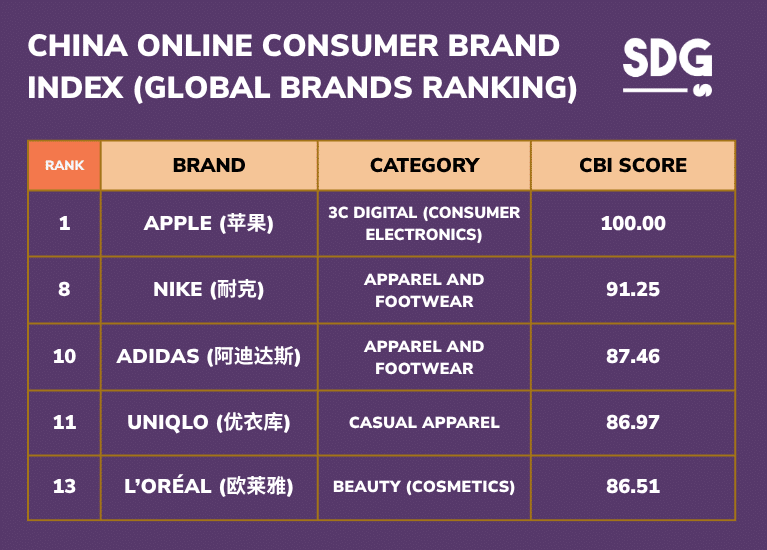
Ranking of Non-Local Brands in the China Online Consumer Brand Index Report
The China Online Consumer Brand Index report also serves as a barometer of market maturity. A higher CBI in product categories means Chinese shoppers are gravitating toward established brands and higher-end goods.
Meanwhile, a lower CBI implies more openness to newcomers and unbranded products regardless of brand perception or prestige when they enter the local market.
How is the brand index calculated?
The CBI is powered by big data from China’s leading e-commerce platforms, covering tens of millions of brands and nearly a billion users. It includes multidimensional metrics, such as search volumes, online retail sales figures, pricing levels, reviews, and customer loyalty indicators.
Advanced brand equity models facilitate the selection and weighting of these indicators.
To put it simply, the leading brands in this report are those that Chinese consumers frequently search for, purchase in high volumes (even at premium prices), and rate highly in user-generated reviews.
5 Notable Market Insights from China’s Consumer Brand Index
1. International Brands Remain Popular in China
Based on the China CBI 500 list, it’s apparent that international brands continue to pique the interests of discerning Chinese consumers. This is despite the rise of Chinese domestic brands fueled by nationalist sentiment and “guochao” trends.
Right now, foreign brands make up nearly one-third of China’s top 500 consumer brands online. Approximately 31.2% of the top 500 companies (and around 36% of the top 100) are international.

Apple Dominates Smartphone Market in China (Source: SCMP)
As one would expect, Apple occupies the top position in the Consumer Brand Index. Other global giants, such as Nike, Adidas, Uniqlo, L’Oréal, and Chanel, are all represented among China’s most valued and top brands.
This means Chinese consumers continue to appreciate many foreign businesses for their quality, brand prestige, and innovation.

Estée Lauder Products in China (Source: Jing Daily)
Specific sectors strongly favor overseas brands, such as beauty & personal care and sports & outdoor apparel. In these categories, international brands account for 60% or more of the top rankings.
Despite a proliferation of local cosmetics startups, Chinese shoppers continue to trust established Western and Japanese/Korean beauty brands for their advanced R&D and quality (e.g., Estée Lauder, Lancôme, Shiseido).
Similarly, in the sportswear industry, brands like Nike and Adidas benefit from decades of global branding and technological advancements in performance gear. This image gives them an edge over many local labels.
What does this mean for foreign brands?
The enduring appeal of international brands in China is encouraging news. It means there is still enough consumer appetite for genuine, high-quality foreign products. However, success is not always automatic.
In highly competitive sectors, overseas brands should leverage their strengths, such as premium positioning, brand novelty, superior technology, or design, while adapting to local digital ecosystems.
2. Strong Brand Loyalty to Digital and Tech Brands
It’s no secret that global tech brands gained immense popularity in China over the years.
However, in the recent CBI 500 list, it became more apparent that Chinese consumers demonstrate extreme loyalty to top-performing brands in the digital and electronics sector.
Both the 3C digital (consumer electronics) and home appliances sectors have the highest consumption quality scores of all industries. Their CBI scores exceed 75, which is significantly higher than the scores of most other categories.
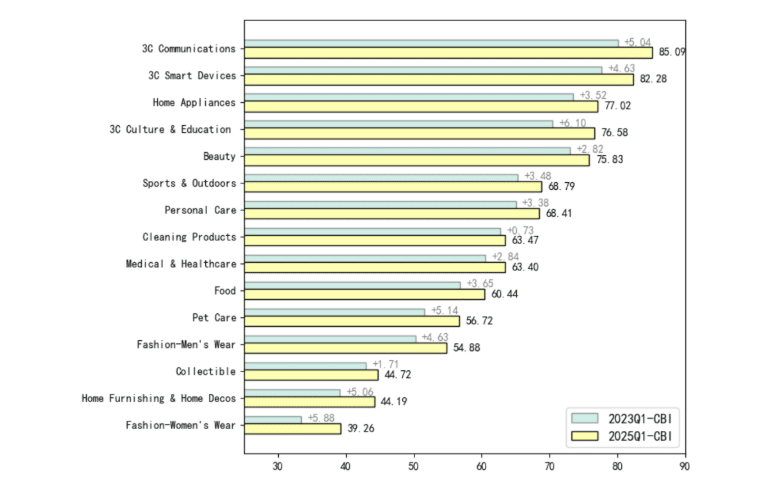
China Online Consumer Brand Index by Product Category (Source: NSD)
In other words, when Chinese shoppers purchase a smartphone or laptop, they overwhelmingly opt for a trusted brand.
This pattern reflects a mature market where there’s a deep consumer engagement. Consumers rely on well-known brands for big-ticket electronics due to the quality assurances, after-sales service, and seamless integration of hardware, software, and services they provide.
What does this mean for foreign brands?
For foreign tech and electronics brands seeking to enter this sector, China’s brand-loyal consumer base presents both opportunities and challenges.
The good news is that if you can establish your offerings as top-tier and high-quality, Chinese customers will show fierce loyalty. They’ll drive repeat sales and positive word-of-mouth.
The bad news is that cracking this market requires unseating (or joining) the top-ranked brands. Nevertheless, consistently delivering high-performing products will earn your brand long-term trust.
3. Growing Brand Purchasing Power from Low-Tier Cities
Another interesting aspect of the China Consumer Brand Index report is the consumer behavior in low-tier cities. This shift is no surprise, especially with the country’s wealth no longer confined to Beijing, Shanghai, Guangzhou, and Shenzhen.
While the top-tier metropolises still rank highest in total spending power, it’s the second-tier and third-tier cities that top the Consumer Brand Index for quality.
In Q1 2025, the Top 10 cities by CBI (brand quality) were all lower-tier cities. This list includes regions such as Hefei, Zhengzhou, Huai’an, and Nanchang.

CBI Ranking by City (Q1 2025)
This data means that shoppers in these cities are buying higher-rated brands on average than even some consumers in Shanghai or Shenzhen.
It also suggests that per capita, consumers in many provincial capitals and smaller cities are catching up in brand affinity, even if the absolute sales in those cities are smaller than in Beijing or Shanghai.
What does this mean for foreign brands?
Brands should expand their marketing and distribution efforts to target these emerging urban regions.
This could involve setting up e-commerce and ad campaigns specifically aimed at customers in interior provinces or tailoring messaging to resonate with local cultures outside the major metropolitan areas.
4. Consistent Seasonal Consumption Peaks
Anyone familiar with China’s e-commerce calendar knows that shopping festivals are the peak of online consumption in the local market.
The CBI report confirms that seasonal surges in consumption are a reliable annual pattern. Chinese consumers tend to splurge in sync with major online sales events and holidays.
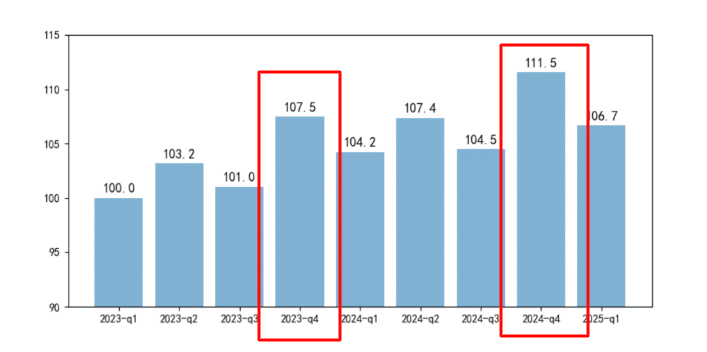
According to the data above, the Q4 each year (around Singles’ Day on November 11th) consistently shows spikes in online consumption.
In the CBI category breakdown, many industries hit their highest index levels in Q4 2024, reflecting the massive Singles’ Day promotions.
Many factors drive these seasonal peaks. E-commerce giants heavily promote these festivals with discounts, coupons, and flash deals, creating a sense of urgency and anticipation among shoppers.
What does this mean for foreign brands?
Timing is everything. To capitalize on China’s consumption cycles, overseas brands should align their marketing and product launches with these established shopping festivals.
It’s also critical to tailor your approach to each festival’s character. For Singles’ Day, competition and noise are incredibly high, so creative campaigns (involving KOLs or viral video content) might help a foreign brand stand out amid thousands of promotional messages.
5. Micro-Niches are Thriving in the Chinese Market
China’s consumer market is more than just the mainstream categories. Micro-niche markets are also thriving.
The CBI report reveals that some of the fastest growth is happening in specialized segments that cater to specific consumer interests or needs. As Chinese consumers diversify their hobbies and lifestyles, brands focusing on niche markets are finding more engaged audiences.

POP MART Products in a Local Store at Xi’an, Shaanxi, China (Source: China Daily)
For example, tapping into micro-niches is a massive part of POP MART’s strategy, fuelling impressive growth not only in China but also globally. Currently, it ranks 31st among the top 500 brands in the CBI report.
Meanwhile, the CBI for pet-related products also increased by more than 5 points from 2023 to 2025. This is because many pet owners in China shifted their niche consumption from basic goods to premium pet food, grooming supplies, and even pet tech gadgets.
What does this mean for foreign brands?
If your brand has a unique specialty, there’s likely a passionate Chinese sub-community searching for those products. The key is to identify the niche and localize your brand message to resonate with that target audience.
Foreign brands can compete by bringing international quality or authenticity to the niche. Engaging with niche KOLs (Key Opinion Leaders) or KOCs (Key Opinion Consumers) on dynamic content platforms like Xiaohongshu can help build credibility within the community.
Why does China CBI 500 matter to global brands?
Benchmarking the “brand-mindedness” of Chinese consumers enables global brands to identify where premiumization is occurring and where gaps remain.
The recent China Online Consumer Brand Index (CBI) report signals that Chinese shoppers are increasingly opting for well-regarded brands over cheap alternatives. Through this list, global brands can pinpoint which product categories have the most brand-loyal consumers, and which city tiers are catching up in terms of appetite for branded goods.
Ultimately, the CBI offers data-backed evidence that Chinese consumers are shifting toward higher-quality, brand-driven consumption.
Quick Q&A
Are foreign brands still popular in China?
Yes, foreign brands remain extremely popular and highly sought after in China. The latest Consumer Brand Index report reveals that international brands account for roughly one-third of China’s top 500 online consumer brands, and an even larger share (approximately 36%) of the top 100 brands.
Which categories favor overseas brands most?
Beauty and personal care, sportswear, and premium consumer electronics are the three categories where overseas labels dominate. In beauty and sports/outdoors, foreign brands still hold a share of over 60% in the top ranking.
Your Trusted Digital Marketing Partner in the Chinese Market!
The data from the China Online Consumer Brand Index reveals that Chinese shoppers still love many international brands and are spending more on quality. However, it also shows that local competition is fiercer than ever, with new Chinese brands innovating rapidly and lower-tier cities rising in importance.
You may also want to read:

At Sekkei Digital Group, we closely monitor the trends and consumption patterns that shape the Chinese market. With our extensive industry experience and first-hand expertise in digital marketing, we can help your brand maximize your reach in China’s digital landscape.

Whether you’re entering the market as a new brand or looking to expand your digital reach, we have the solutions you need! Get in touch with our team, and let’s start mapping your next campaign.

References:
China Online Consumer Brand Index (NSD)
Three Winning Strategies from Top Brands